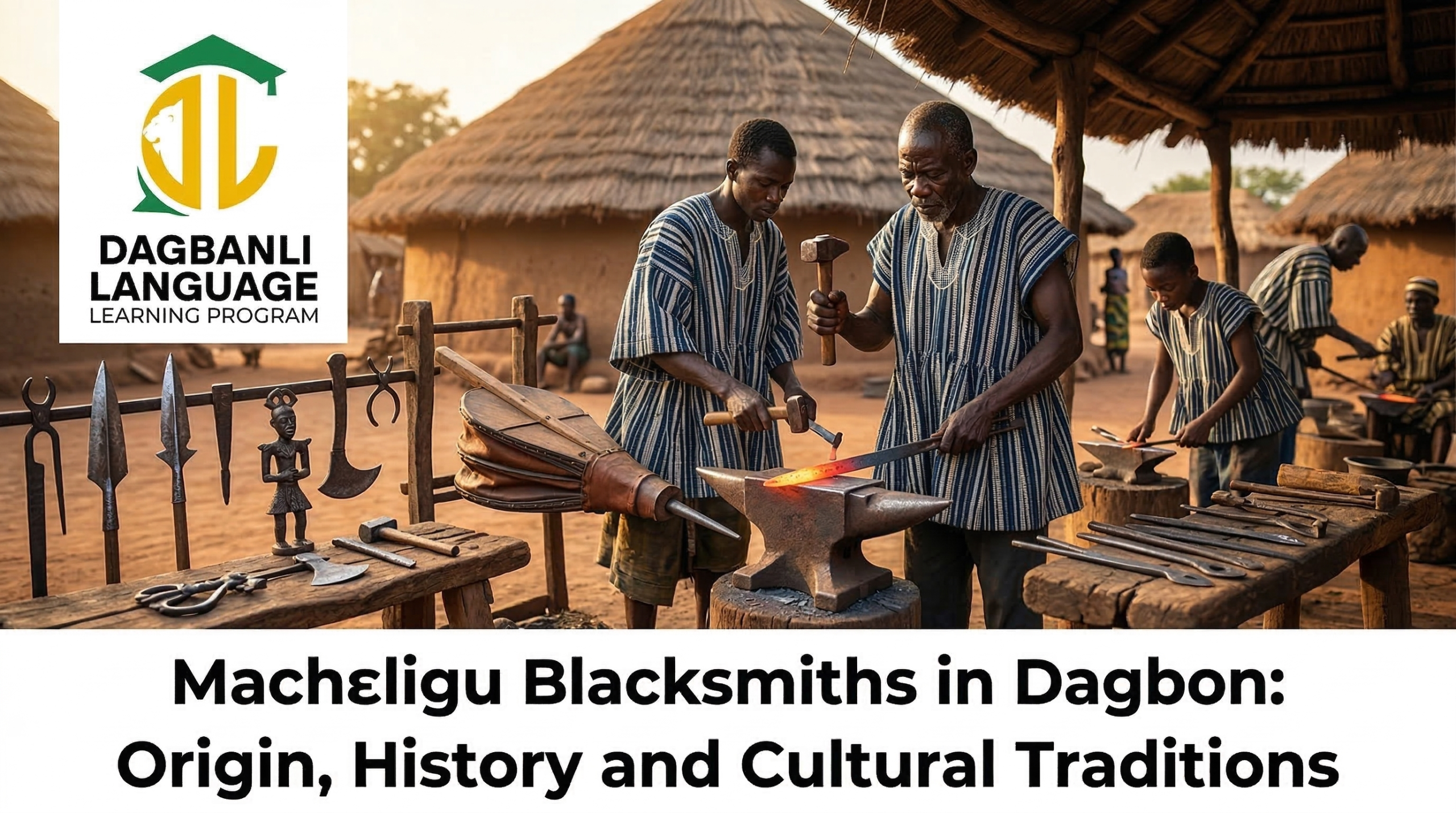
The story of Machɛligu Blacksmiths in Dagbon is deeply connected to the history, technology, and culture of the Dagbamba people. For centuries, the Machɛligu Blacksmiths in Dagbon have forged the tools, weapons, and sacred objects that supported farmers, warriors, and chiefs across the kingdom. From the ancient ironworkers believed to have lived in the savanna long before the rise of the Gbewaa dynasty to the legendary engineering achievement during the reign of Naa Luro, the Machɛligu Blacksmiths in Dagbon remain one of the most respected professional groups in Dagbon society.
Ancient Roots of Blacksmithing in Dagbon
The Aboriginal Ironworkers
Long before the rise of the Gbewaa dynasty and the establishment of centralized rule in Dagbon, the land was already inhabited by earlier communities who possessed remarkable knowledge of ironworking. These early inhabitants are often referred to in oral traditions as the Dagbon Sablisi, meaning the “Black Dagombas” or the aboriginal people who lived in the region before the arrival of the ruling dynasty. They lived in scattered settlements across the savanna and organized their communities around clan leadership and spiritual authority held by the tindaamba, the custodians of the land and its shrines.
Among these early inhabitants were skilled ironworkers who understood how to locate iron ore, smelt it in furnaces, and shape it into useful tools. Their iron technology supported daily life by producing farming implements, hunting weapons, and household tools that helped sustain the early communities. Archaeological discoveries and oral traditions suggest that iron smelting sites once existed across parts of northern Ghana, confirming that ironworking was practiced in the region long before the formation of the Dagbon kingdom. These early technological traditions later influenced the development of the professional guild known today as the Machɛligu Blacksmiths in Dagbon, whose craft would become essential to the military strength, agricultural productivity, and cultural identity of the Dagbamba people.
The Legend of the Tiyawumya Giants
Among the most fascinating oral traditions about the early inhabitants of Dagbon is the story of the Tiyawumya, sometimes referred to as the Adites. According to elders and traditional narrators, these people were believed to be giants who lived in the region long before the arrival of the Gbewaa dynasty. They were described as exceptionally tall and powerful, possessing great skill in metalworking and iron smelting. Because of their remarkable physical strength and technological knowledge, many stories portray them as the first great ironworkers of the savanna.
Local traditions say the Tiyawumya wandered across the land searching for iron ore deposits. Wherever they settled, they established furnaces where iron was smelted and shaped into tools and weapons. Over generations, these activities created an early iron industry that supported hunting, farming, and community life. The legacy of these ancient ironworkers is sometimes linked to unusual artifacts discovered across parts of northern Ghana.
Farmers in several communities occasionally uncover large iron rings and metal objects buried in the soil, some measuring more than thirty inches in diameter. Because of their extraordinary size and unknown origin, local people often describe them as relics left behind by the giants. These artifacts are sometimes referred to as the “treasure of the giants,” reinforcing the belief that the Tiyawumya once practiced advanced ironworking techniques in the region.
Although historians continue to study the origins of these traditions, the legend of the Tiyawumya remains an important part of Dagbon oral history. The stories highlight the deep roots of iron technology in the area and suggest that long before the rise of kings and organized states, early communities had already developed the skills that would later shape the profession of blacksmithing in Dagbon.
The Historic Turning Point: Naa Luro’s Bridge
The Death of Yaa Naa DariӠiɛɣu
For many years, oral narratives commonly described the death of Yaa Naa DariӠiɛɣu as occurring during a conflict between Dagbon and the Gonja. However, more recent historical reflections and chronological studies have raised important questions about this interpretation. Historians now point out that during the reign of Yaa Naa DariӠiɛɣu in the mid-sixteenth century, the Gonja Kingdom had not yet been formally established as a centralized state. This observation has led scholars and traditional historians to reconsider the circumstances surrounding his death.
According to these newer interpretations, the area where Yaa Naa DariӠiɛɣu was killed was inhabited by the Tampulma people, an ethnic group who still live in that region today. Although the Tampulma later became incorporated into the Gonja political sphere, they were at that time independent communities. Oral accounts suggest that Yaa Naa DariӠiɛɣu had travelled into the area not as part of a military expedition, but rather on a personal visit to relatives from his mother’s side, since his mother is believed to have been of Tampulma origin.
During this journey, the king was reportedly murdered by a Tampulma individual, an event that shocked the Dagbon court and created deep anger within the kingdom. When Yaa Naa Luro ascended the Lion Skin of Dagbon, one of his first responsibilities was to respond to this tragedy. Determined to avenge the fallen king and reaffirm the strength of the kingdom, he began preparing for a major military expedition toward the region where the incident had occurred.
Warriors were summoned from different divisions of Dagbon, and the royal cavalry—well known for its discipline and speed—was assembled for the campaign. Elders, captains, and royal princes joined the preparations as the kingdom mobilized its forces. The expedition moved during the rainy season toward the Tampulma-inhabited territories, a journey that would soon present the army with a serious natural obstacle.
These preparations eventually led to the famous expedition during which the ingenuity of a blacksmith helped the royal army overcome a flooded river, an event that would later become an important turning point in the story of blacksmithing in Dagbon.
Crossing the Flooded River
As the royal expedition moved deeper into the savanna during the rainy season, the army of Yaa Naa Luro soon encountered a serious natural barrier. The forces eventually arrived at a river known in the oral traditions as Yilinŋ-gini, located within the Diare catchment area. During the dry season, this river could normally be crossed without much difficulty, but the heavy rains had caused the waters to rise and overflow their banks.
The swollen river created a dangerous obstacle for the advancing army. The fast-moving current made it impossible for warriors, horses, and supplies to pass safely. Since the campaign was already underway and the king’s forces could not afford to delay their mission for long, the situation posed a major challenge to the success of the expedition.
Faced with this unexpected difficulty, the king and his commanders needed a practical solution that would allow the army to cross the flooded river and continue their journey. It was at this critical moment that the skills of a blacksmith were called upon, leading to a remarkable act of ingenuity that would later become a famous story in the history of Machɛligu Blacksmiths in Dagbon.
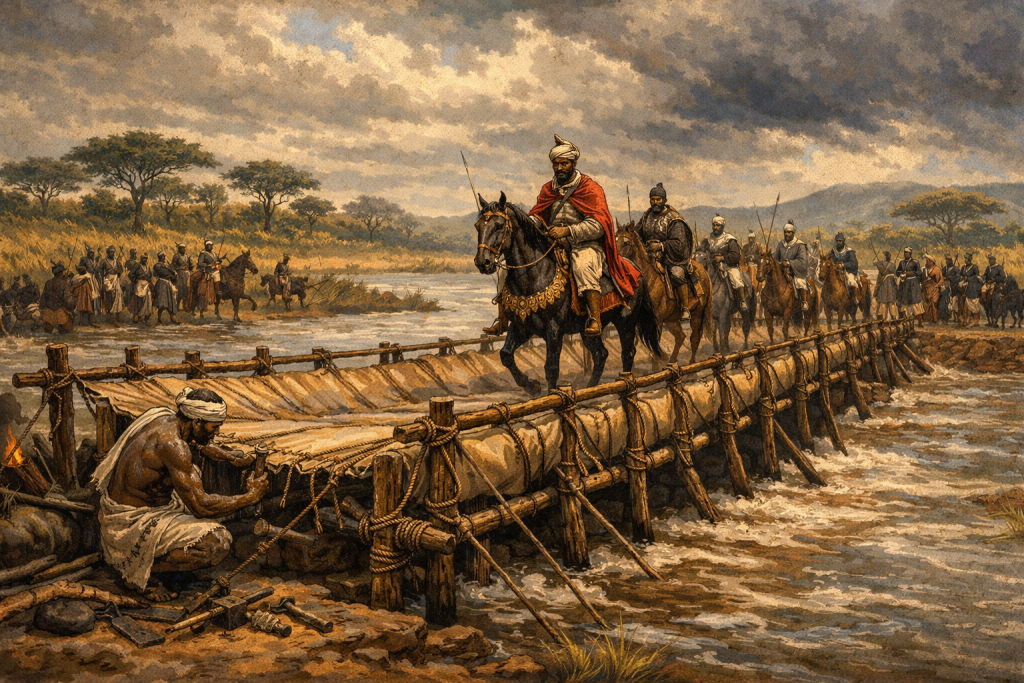
The Blacksmith’s Engineering Miracle
With the royal army halted by the flooded waters of Yilinŋ-gini, a solution had to be found quickly if the expedition was to continue. At this crucial moment, the king called upon the skills of a blacksmith—one of the craftsmen whose knowledge of materials and construction could help overcome the natural barrier. This moment would later become one of the most famous stories associated with the Machɛligu Blacksmiths in Dagbon.
To provide the materials needed for the task, nine goats belonging to Yaa Naa Luro were slaughtered, and their skins were carefully removed. These goat skins were then used by the blacksmith to construct a temporary structure that could withstand the strong current of the flooded river. Using his understanding of binding, stretching, and reinforcing materials, the blacksmith fashioned the skins into a form that acted as a bridge across the water.
Through this ingenious construction, the army of Dagbon was able to cross the river safely. Warriors, horses, and supplies moved across the improvised bridge, allowing the expedition to continue its journey toward the territory where the king intended to avenge the death of his predecessor. The success of this engineering solution demonstrated the extraordinary practical knowledge possessed by traditional craftsmen and elevated the status of the Machɛligu Blacksmiths in Dagbon, whose skills proved essential not only in forging tools and weapons but also in solving critical challenges faced by the kingdom.
The Blacksmith Guild in Dagbon
Blacksmithing in Dagbon is not just an occupation; it is a hereditary profession organized within a recognized social group. The practitioners of this craft are traditionally associated with the Saɣiyelsi clan, a lineage known for its mastery of ironworking and metal craftsmanship. Members of this clan have, for generations, preserved the knowledge of smelting, forging, and shaping iron into the tools and weapons that support everyday life in Dagbon.
Because the craft requires specialized skills passed down through experience and observation, blacksmithing is usually learned within blacksmith families. Young boys born into these households grow up watching their fathers and elders work in the Saviɣu, the blacksmith workshop. Over time they learn how to prepare the fire, handle the iron, and use the various tools needed to shape metal. Through this process, the techniques and traditions of the craft are carefully transmitted from one generation to the next.
Across many communities in Dagbon, these blacksmith families form a respected professional network. They provide essential services to farmers, hunters, and warriors by producing hoes, knives, spears, and other metal tools. In this way, the Saɣiyelsi clan and other blacksmith families have played an important role in sustaining the economic and social life of the kingdom, ensuring that the skills of the Machɛligu Blacksmiths in Dagbon continue to survive through generations.
Leadership Structure
Like many professional groups in the Dagbon kingdom, the Machɛligu Blacksmiths in Dagbon are organized under a traditional leadership system that helps regulate the craft and maintain its customs. These leaders serve as custodians of the profession, ensuring that the knowledge, discipline, and cultural practices associated with blacksmithing are preserved and respected within the community.
The leadership structure includes several important titles:
- Yidan-Borigu – The supreme head of all blacksmiths in Dagbon. The Yidan-Borigu, based in Yendi, serves as the highest authority among blacksmiths and oversees matters concerning the guild across the kingdom.
- Zana Naa – A senior title within the blacksmith hierarchy who assists in maintaining the traditions and organization of the craft in certain communities.
- Faamuru – Another important office among the blacksmiths, often associated with respected elders who have deep knowledge of the profession and its customs.
- Shɛlunŋ – A title connected to blacksmith leadership within particular localities, helping to coordinate the activities of blacksmith families in those areas.
- So-Naa – A recognized chief among blacksmiths whose influence and authority extend within communities where the blacksmith profession is practiced.
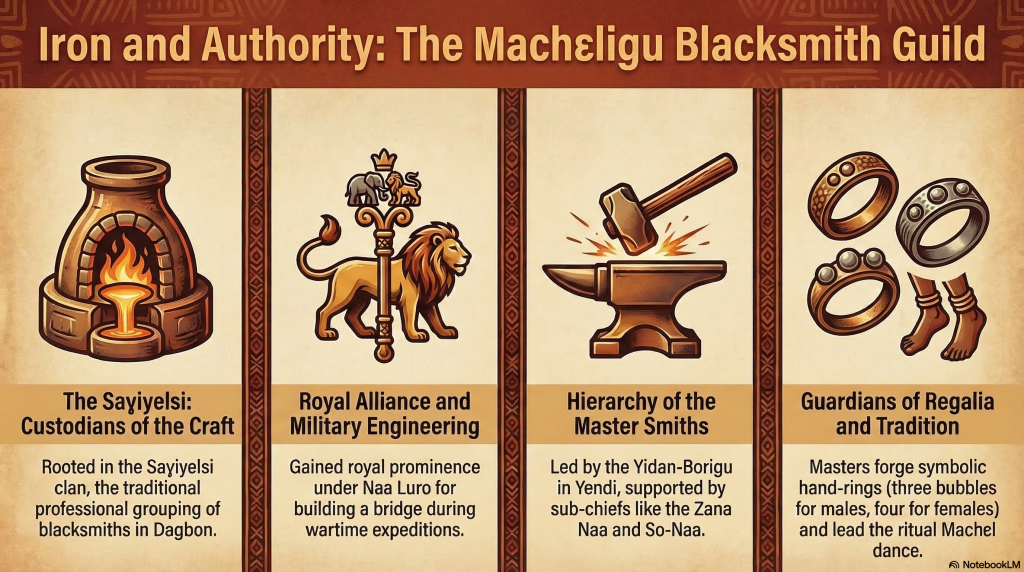
Together, these titles form a structured leadership system that guides the activities of blacksmith families, settles disputes, and protects the traditions of the Machɛligu Blacksmiths in Dagbon. Through this organization, the craft continues to maintain its dignity and importance within Dagbon society.
The Saviɣu: The Blacksmith Workshop
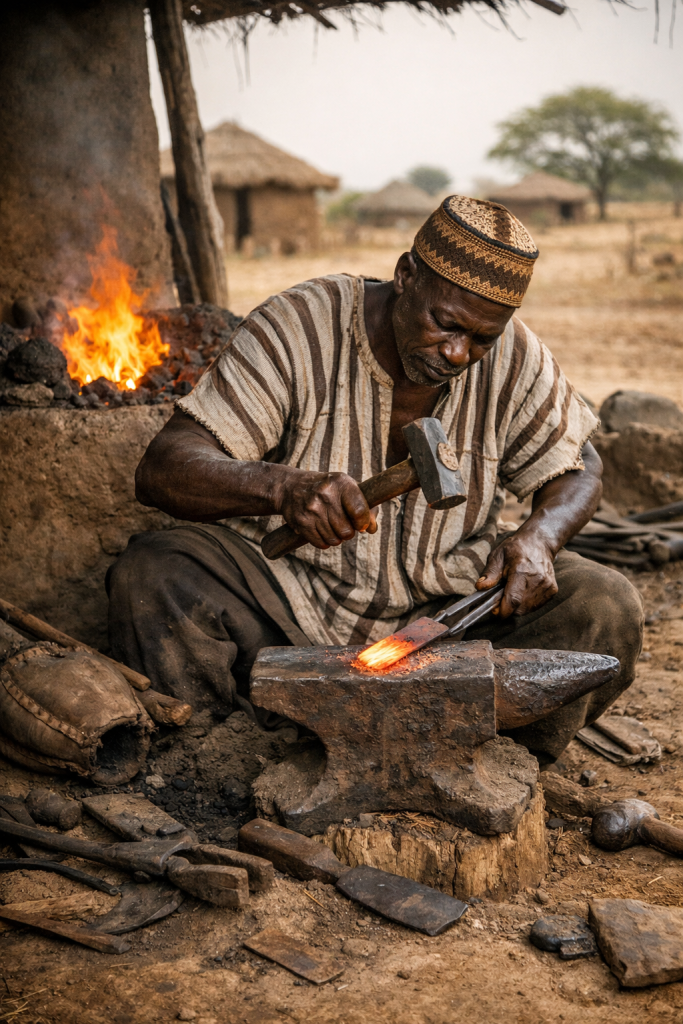
In Dagbon society, the workplace of a blacksmith is known as the Saviɣu. This is the traditional workshop where iron is heated, shaped, and transformed into useful tools and weapons. The Saviɣu is more than just a place of work; it is considered a respected and disciplined space where the knowledge of metalworking is practiced and passed from one generation to the next.
Within the Saviɣu, the blacksmith carefully controls fire and iron to produce farming tools, hunting weapons, and household implements that support daily life in Dagbon communities. It is also the place where young apprentices observe and learn from experienced craftsmen. Because of its importance, the Saviɣu is often associated with certain customs and professional discipline. Blacksmiths are expected to attend regularly, respect the tools of the craft, and maintain the order of the workshop.
Tools of the Blacksmith
Several specialized tools are used inside the Saviɣu to shape iron and complete the work of the blacksmith. Some of the most important tools include:
- Ӡali – the anvil or striking surface on which hot iron is hammered and shaped.
- Zuɣurigu – a tool used to fan the fire and intensify the heat needed for forging metal.
- Chiriga – iron tongs used to hold and control heated metal while it is being worked.
- Kpobo – a heavy hammer or forging tool used to strike and shape the iron during the smithing process.
Together, these tools form the essential equipment of the blacksmith’s workshop and allow the Machɛligu Blacksmiths in Dagbon to transform raw iron into the objects that serve the needs of the community.
The Mark of a True Blacksmith
Within the tradition of the Machɛligu Blacksmiths in Dagbon, skill is not only judged by the quality of the tools produced but also by the technique and discipline displayed while working. One of the most recognized signs of a genuine blacksmith is the way he holds the Chiriga, the iron tongs used to grip and control heated metal during the forging process.
A true blood blacksmith is known to hold the Chiriga using only three fingers — the thumb and two other fingers. This method requires strength, precision, and long experience in handling hot iron. The grip allows the blacksmith to maneuver the metal confidently while shaping it on the Ӡali (anvil). Among experienced craftsmen, this technique is considered a mark of mastery that distinguishes someone who has grown within the tradition of the craft.
By contrast, a wielder or straighter, often an assistant or someone who has not fully inherited the blacksmith lineage, typically holds the Chiriga with all five fingers. This grip is considered less refined and signals that the person may be helping in the workshop but has not yet attained the full status of a professional blacksmith.
This simple but meaningful difference in technique reflects how deeply the traditions of the Machɛligu Blacksmiths in Dagbon value skill, lineage, and the careful transmission of knowledge from one generation to the next.
Social Role of Machɛligu Blacksmiths in Dagbon
In Dagbon society, the work of blacksmiths goes far beyond shaping iron. The Machɛligu Blacksmiths in Dagbon play a vital role in supporting the daily life, economy, and defense of the kingdom. Through their craftsmanship, they provide the essential tools that farmers, hunters, warriors, and households depend upon.
One of their most important contributions is the production of farming tools. Since agriculture is the backbone of life in Dagbon, blacksmiths forge implements such as hoes and other metal tools used for cultivating the land. These tools allow farmers to prepare their fields, plant crops, and sustain their families and communities.
Blacksmiths are also responsible for producing weapons used in warfare and hunting. Historically, Dagbon warriors relied on metal weapons crafted by blacksmiths, including swords, knives, spearheads, and other iron implements. These weapons were crucial in protecting the kingdom and maintaining its authority during times of conflict.
In addition, blacksmiths produce a variety of household tools and everyday items. Knives used in kitchens, cutting tools for craftwork, and other metal objects used in daily activities are commonly forged in the blacksmith’s workshop. Through these contributions, the Machɛligu help sustain both the economic and domestic life of the community.
The Playmate Relationship with Butchers
An interesting cultural relationship exists between blacksmiths and butchers (Nakohima) in Dagbon society. The two groups are traditionally considered playmates, meaning they share a friendly but playful rivalry that is expressed during certain social events.
This relationship becomes especially visible during the funeral of a respected butcher. When such a person passes away, blacksmiths may attend the funeral carrying various tools from their workshops, including knives, swords, hoes, and other iron implements. During the ceremony, they humorously accuse the deceased butcher of theft or wrongdoing in a joking manner. These playful accusations are not meant to insult the deceased but rather serve as a traditional expression of the bond between the two professional groups.
Customarily, butchers are expected to remain calm during these moments and not respond with hostility. The ritual symbolizes the long-standing friendship and cultural connection between the professions, reflecting how different occupational groups interact within the broader social structure of Dagbon.
Cultural Traditions of the Blacksmiths
Beyond their work with iron and fire, the Machɛligu Blacksmiths in Dagbon maintain rich cultural traditions that express their identity and connection to the wider community. Music and dance play an important role in these traditions, especially during important social events such as funerals and communal gatherings. Among the most notable musical expressions associated with blacksmiths is the Sabaani, also known as Dikala.
Sabaani (Dikala) Music
The Sabaani are metal clappers crafted by blacksmiths themselves. These instruments are made from iron and are struck together rhythmically to produce a sharp metallic sound that carries strongly through large gatherings. Because they are forged by blacksmiths, the Sabaani instruments symbolize both the craft and the cultural presence of the Machɛligu within Dagbon society.
Sabaani music is commonly performed during funeral ceremonies, particularly those held in honor of elderly members of the community. During these events, performers use the metal clappers to produce powerful rhythmic patterns that accompany traditional dances and chants. The sound of the Sabaani creates a unique atmosphere that blends mourning with celebration, reflecting the Dagbon belief in honoring the life and legacy of the departed.
Through these performances, the Machɛligu Blacksmiths in Dagbon demonstrate that their role extends beyond the forge. Their craft not only shapes tools and weapons but also contributes to the musical and ceremonial traditions that strengthen the cultural life of the kingdom.
Machɛl Dance
Another important cultural expression associated with the Machɛligu Blacksmiths in Dagbon is the Machɛl dance, sometimes referred to as Ӡali in certain traditions. This dance is closely connected to the identity and heritage of blacksmith families and is often performed during community gatherings and ceremonial occasions. The rhythm and movement of the Machɛl dance reflect the strength, energy, and pride of the blacksmith profession within Dagbon society.
One striking feature of the Machɛl dance is the belief that its powerful rhythms can sometimes lead to spiritual possession, particularly among individuals who belong to blacksmith lineages. According to traditional belief, when the music and rhythms of the dance are played, some members of the blacksmith families—especially those who may have tried to distance themselves from the profession—can become spiritually overwhelmed and enter a trance-like state. This experience is often interpreted as a reminder of their ancestral connection to the craft and their inherited responsibility to the tradition.
Beyond its spiritual aspect, the Machɛl dance also serves as an important marker of cultural identity. It celebrates the heritage of blacksmith families and strengthens their sense of belonging within the broader Dagbon community. Through music, dance, and shared participation, the Machɛl dance preserves the traditions of the Machɛligu Blacksmiths in Dagbon and reminds younger generations of the deep cultural roots of their profession.
Traditional Symbols Crafted by Blacksmiths
In addition to forging tools and weapons, the Machɛligu Blacksmiths in Dagbon are also known for crafting symbolic metal objects that carry cultural and spiritual meaning. Among these items are traditional hand rings, which are worn not only as ornaments but also as objects associated with identity, protection, and social recognition within the community.
These rings are carefully forged from metal by blacksmiths and are designed with distinctive shapes that reflect cultural symbolism. A common design features raised bubbles on the top of the ring, and the number of these bubbles traditionally indicates whether the ring is intended for a man or a woman. Rings made for men typically have three bubbles, while those crafted for women have four bubbles. This difference in design serves as a simple but meaningful way of distinguishing gender through traditional jewelry.
In some communities, particularly in areas such as Zabzugu, these rings are known as Mɔchankpuni. Many people regard them as more than ordinary ornaments. They are sometimes associated with spiritual protection or believed to possess symbolic power connected to traditional beliefs. Because of this, they may be treated with respect and occasionally referred to as lesser spiritual objects within local traditions.
Through the crafting of these rings and other symbolic items, the Machɛligu Blacksmiths in Dagbon demonstrate that their work extends beyond practical tools. Their craftsmanship also contributes to the cultural expressions, identity markers, and traditional beliefs that form an important part of Dagbon heritage.
The Legacy of Machɛligu Blacksmiths in Dagbon
The legacy of the Machɛligu Blacksmiths in Dagbon continues to hold great importance in the cultural and social life of the Dagbamba people. Although modern technology and imported tools have changed the way many communities access metal implements, traditional blacksmiths still play a respected role in preserving the skills and knowledge that shaped the early development of the kingdom.
Today, blacksmiths remain important in many rural communities where locally forged tools are still valued for their durability and practicality. Farmers, hunters, and craftsmen often rely on blacksmiths to repair or produce metal tools that are suited to local needs. Beyond their practical work, the Machɛligu Blacksmiths in Dagbon also serve as custodians of an ancient craft that connects the present generation to the technological traditions of the past.
Their work forms part of the broader cultural heritage of Dagbon. The stories associated with blacksmithing—from the legendary bridge built during the reign of Yaa Naa Luro to the musical traditions and ceremonial roles of blacksmith families—continue to be told by elders and cultural historians. These traditions remind the community that blacksmiths have long contributed to the survival, defense, and prosperity of the kingdom.
Equally important is the preservation of knowledge. The techniques of forging iron, controlling fire, and shaping metal are traditionally passed from father to son or through apprenticeships within blacksmith families. This method of learning ensures that the craft is not lost as generations change. By maintaining the workshops, tools, and customs of the profession, the Machɛligu Blacksmiths in Dagbon help safeguard an important part of Dagbon’s historical identity for future generations.
Conclusion
The story of the Machɛligu Blacksmiths in Dagbon reveals how deeply technology, culture, and tradition are woven into the history of the Dagbamba people. From the ancient ironworkers believed to have lived in the land long before the rise of the Gbewaa dynasty to the famous engineering feat during the reign of Yaa Naa Luro, blacksmiths have consistently played an important role in shaping the kingdom.
Through their mastery of iron, they produced the farming tools that sustained communities, the weapons that protected the kingdom, and the symbolic objects that carried cultural meaning. Their workshops, music, and traditions have also contributed to the social and ceremonial life of Dagbon.
Even today, the legacy of the Machɛligu Blacksmiths in Dagbon continues to reflect resilience, craftsmanship, and cultural pride. Their work stands as a living reminder of the ingenuity and enduring heritage of the Dagbamba people, linking the knowledge of the past with the identity of present and future generations.
Read More: History Part 1: Naa Zanjina and the creation of the three gate skins