Understanding the Dagbanli alphabet and pronunciation opens the door to one of West Africa’s most fascinating tonal languages. Spoken primarily in Northern Ghana, Dagbanli presents unique challenges for English speakers, from its special characters to its melody-like tonal system.
This comprehensive guide breaks down everything you need to know about Dagbanli’s writing system and sounds.
Read More: The History Of Mole Dagbon State
Table of Contents
- Why Dagbanli Feels Challenging for Beginners
- The Five Special Letters You Must Know
- Letters That Don’t Exist in Dagbanli
- Mastering Double Consonants (Digraphs)
- Understanding Tone in Dagbanli
- Practical Tips for Learning Dagbanli Pronunciation
Why Dagbanli Feels Challenging for Beginners
Learning the Dagbanli alphabet and pronunciation requires patience because this language operates differently from English in three fundamental ways.
First, Dagbanli is a tonal language. The pitch of your voice determines meaning. Two words can share identical spelling but mean completely different things based on whether you say them with a high or low tone.
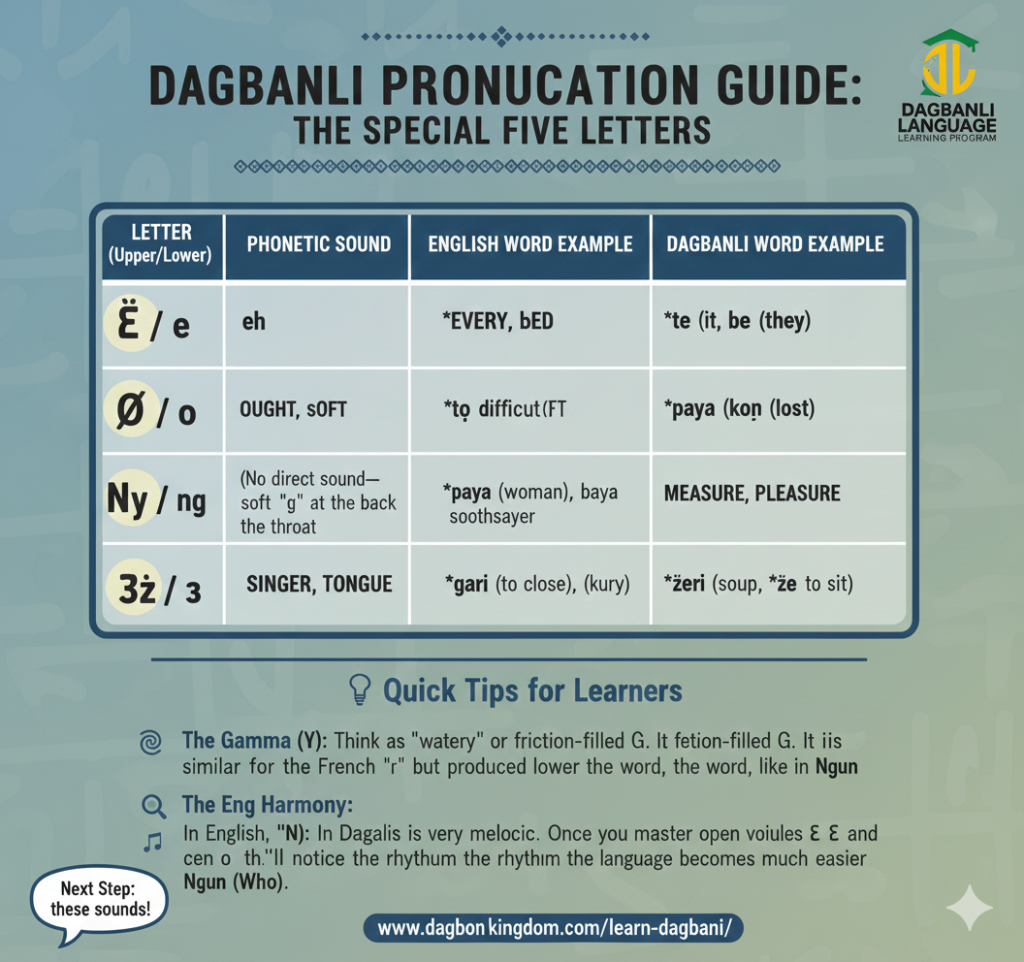
Second, the alphabet includes special characters like ɛ, ɔ, Ɣ, Ŋ, and Ʒ. These letters represent sounds that don’t exist in English, forcing learners to train their mouths to produce entirely new sounds.
Third, certain letter combinations like “gb” and “kp” must be pronounced simultaneously—not as separate sounds, but as one unified sound produced by coordinating different parts of your mouth.
However, there’s good news. Once you master pronunciation, writing becomes easier than English. Dagbanli follows strict phonetic rules. Each letter consistently produces the same sound, unlike English where “ough” changes pronunciation in “through,” “tough,” and “thought.”
The language excludes the letters C, Q, and X from its native vocabulary, creating a streamlined alphabet system.
The Five Special Letters You Must Know
1. Ɛ ɛ (Open E)
Sound: This letter produces the “e” sound in “bed,” “set,” or “men.” Linguists call it an “open-mid front vowel.”
How to Say It: Open your mouth slightly wider than when saying the standard “e” (as in “they”). Think of the difference between “bed” and “bade.”
Read More: Exploring the Golden Era Of Dagbon Kingdom: The Impact of Moliyili Scholars and Its Fall
Common Mistakes:
- Beginners often treat standard “e” and special “ɛ” as interchangeable
- Unlike other vowels, ɛ never appears doubled in native Dagbanli words
2. Ɔ ɔ (Open O)
Sound: This creates a deep “aw” sound, similar to “law” or the “o” in “cot” and “hot.”
How to Say It: Round your lips and open your mouth wider than for a regular “o” (as in “go”).
Common Mistakes:
- Confusing it with standard “o”
- Looking for doubled forms (ɔɔ doesn’t exist in native words)
3. Ɣ ɣ (Gamma)
Sound: This challenging letter is a voiced velar fricative—essentially a gentle throat sound similar to clearing your throat softly. English speakers might recognize it as similar to “gh” in “ugh” or the “ch” in the German name “Bach.”
How to Say It: Produce the sound deep in your throat, like a soft gargle.
Common Mistakes:
- Critical Rule: Ɣ never starts a word in Dagbanli. It only appears in the middle or end.
- Pronouncing it as a hard “g” or “h”
- Example: The word “paɣa” (woman) should not sound like “paga” or “paha”
4. Ŋ ŋ (Eng)
Sound: This represents the “ng” sound in “sing,” “ring,” or “tongue.”
How to Say It: Make a smooth nasal sound through your nose, exactly like the end of “king.”
Common Mistakes:
- The “Finger” Error: Don’t pronounce it like “finger,” which includes a hard “g” click (ng-g). Dagbanli Ŋ is one smooth sound.
- Unlike English where “ng” typically ends words, in Dagbanli this sound can start words (example: ŋmani – calabash)
5. Ʒ ʒ (Ezh)
Sound: This voiced postalveolar fricative sounds like the “s” in “measure,” “pleasure,” or “vision,” or the “g” in “genre.”
How to Say It: Create a soft “zh” buzz with your tongue near the roof of your mouth.
Common Mistakes:
- Confusing it with standard “z” or English “j”
- This specific friction sound doesn’t have a single-letter equivalent in English
Letters That Don’t Exist in Dagbanli
The native Dagbanli writing system excludes three English letters: C, Q, and X.
Why They’re Missing:
- Q and X represent sounds not found in native Dagbanli vocabulary
- C never exists as a single letter
The Rule for “C”:
C only appears combined with H to form the digraph “Ch,” which sounds exactly like English “ch” in “church” or “chair.”
Example: Cheche (Bicycle)
Mastering Double Consonants (Digraphs)
Dagbanli double consonants are pairs of letters that create one unified sound. They cannot be separated or pronounced individually.
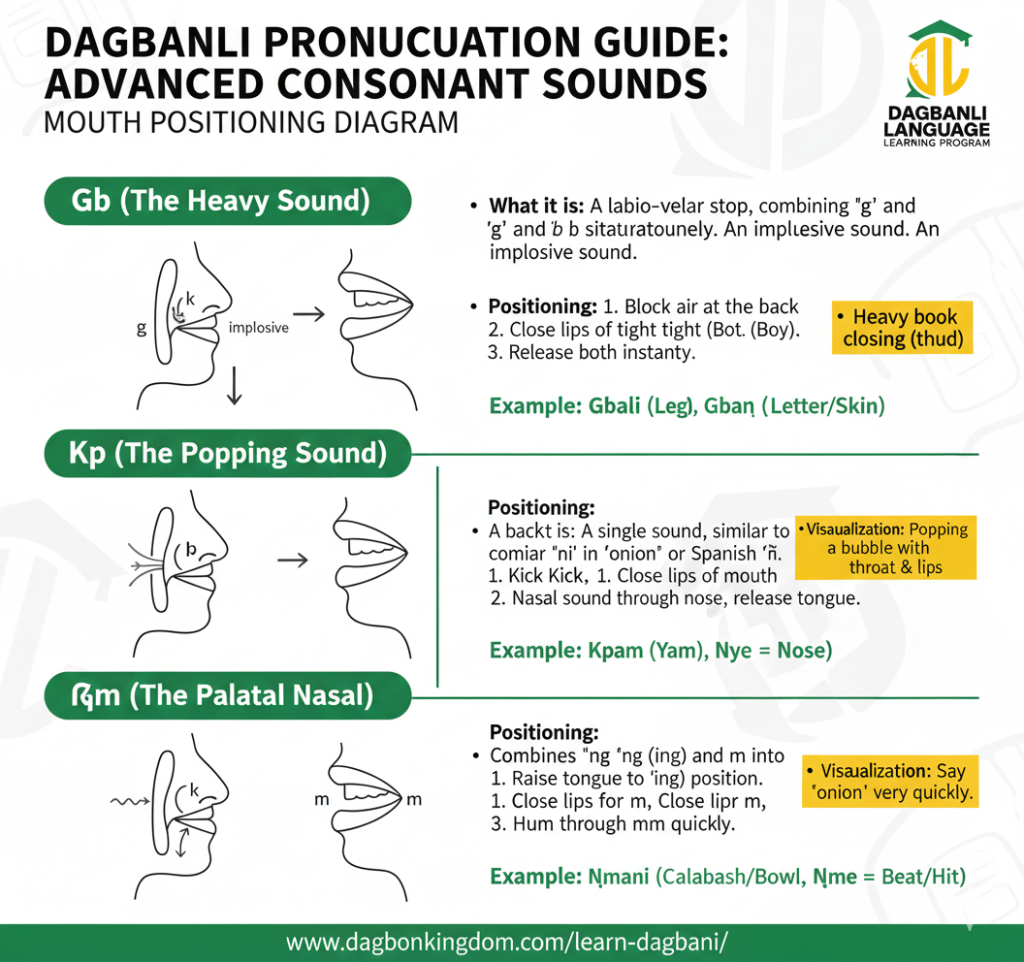
Gb (The Heavy Sound)
What It Is: A labio-velar stop where you pronounce “g” and “b” simultaneously. It’s an “implosive” sound that feels heavy and deep.
How to Produce It:
- Block air at the back of your throat (like saying “Go”)
- Close your lips tight (like saying “Boy”)
- Release both at the exact same moment
Visualization: Imagine closing a heavy book with a deep “thud”—that implosive feeling captures the Gb sound.
Examples:
- Gbali (Leg)
- Gbaŋ (Letter/Skin)
Kp (The Popping Sound)
What It Is: A labio-velar voiceless stop requiring simultaneous “k” and “p” pronunciation.
How to Produce It:
- Block air with the back of your tongue (like “Kick”)
- Close your lips (like “Pot”)
- Release them at the same time
Visualization: Imagine popping a bubble with both your throat and lips simultaneously.
Examples:
- Kpam (Oil)
- Kpɛ (Enter)
Ny (The Palatal Nasal)
What It Is: A single sound similar to “ni” in “onion” or “ñ” in Spanish “niño.”
How to Produce It:
- Press the flat part of your tongue against your hard palate (roof of your mouth)
- Make a nasal sound through your nose while releasing the tongue
Visualization: Say “onion” very quickly, blending the “ni” into one smooth sound.
Examples:
- Nyuli (Yam)
- Nyee (Nose)
Ŋm (The Nasal Cluster)
What It Is: This combines the “ng” sound (from “sing”) and “m” into one smooth, simultaneous sound.
How to Produce It:
- Raise the back of your tongue to the “ng” position (as in “king”)
- Close your lips for “m”
- Hum through your nose while maintaining both positions
Visualization: Say “ng” and hum “mm” very quickly together.
Examples:
- Ŋmani (Calabash/Bowl)
- Ŋme (Beat/Hit)
Understanding Tone in Dagbanli
Dagbanli is a tonal language, meaning pitch changes meaning. This is perhaps the most important aspect of Dagbanli pronunciation.
The Golden Rule
It’s not just what letters you say—it’s how you sing them.
Two words can be spelled identically but mean completely different things based on voice pitch. Think of tone like musical notes where your voice is the instrument.
Same Letters, Different Meanings
1. BAA
- High Tone (Báá): Dog
- Low Tone (Bàà): Stream (or river)
2. WAHU
- High Tone (Wáhú): Snake
- Low Tone (Wàhù): Horse
3. PALLI
- High Tone (Pállí): New (something new)
- Low Tone (Pàllì): Road
4. GALLI
- High Tone (Gálá): Misdeed (doing badly)
- Low Tone (Gàlà): Eggs
Why Tone Matters More Than Spelling
Standard Dagbanli writing doesn’t always mark these tones. A single spelling like “baa” could mean either “dog” or “stream” depending entirely on how you say it.
This makes listening to native speakers essential. You cannot fully learn Dagbanli alphabet and pronunciation from written materials alone.
Additionally, vowel length affects meaning. Shortening or lengthening a vowel transforms words completely. For instance, “ba” (father) becomes “baa” (dog) when you extend the vowel.
Practical Tips for Learning Dagbanli Pronunciation
Listen to Native Speakers
Audio exposure is non-negotiable for learning Dagbanli pronunciation. Find recordings, videos, or conversation partners. Your ear must learn the tonal patterns before your mouth can reproduce them.
Practice Special Letters Daily
Dedicate time to the five special letters. Record yourself saying ɛ, ɔ, Ɣ, Ŋ, and Ʒ, then compare with native pronunciation. Small daily practice builds muscle memory.
Master One Digraph at a Time
Don’t rush the double consonants. Spend a week focusing solely on Gb, then move to Kp. These sounds require physical coordination that develops gradually.
Use Minimal Pairs
Practice words that differ only in tone (like báá/bàà). This trains your ear to distinguish pitch differences and your voice to produce them consistently.
Embrace the Phonetic Advantage
Remember that Dagbanli spelling is phonetic. Once you know how each letter sounds, reading becomes predictable. Unlike English, letters don’t change sounds between words.
Be Patient with Ɣ
The Gamma sound (Ɣ) challenges most English speakers. Don’t expect immediate success. Practice the gentle throat sound repeatedly, and remember it never starts words.
Conclusion
The Dagbanli alphabet and pronunciation system may initially seem complex, but its logical structure rewards dedicated learners. Special letters like ɛ, ɔ, Ɣ, Ŋ, and Ʒ represent unique sounds, while digraphs like Gb and Kp require coordinated articulation.
Tone distinguishes meaning in ways unfamiliar to English speakers, making audio practice essential. Yet the phonetic consistency of Dagbanli spelling simplifies reading once pronunciation is mastered.
Start with the special letters, progress to double consonants, and immerse yourself in native speaker audio to internalize the tonal patterns. Every sound you master brings you closer to communicating in this rich West African language.
Recommended Resources
West African Tonal Languages Study – Academic research on tone systems
Dagbani Language and Culture Resources – Comprehensive linguistic documentation