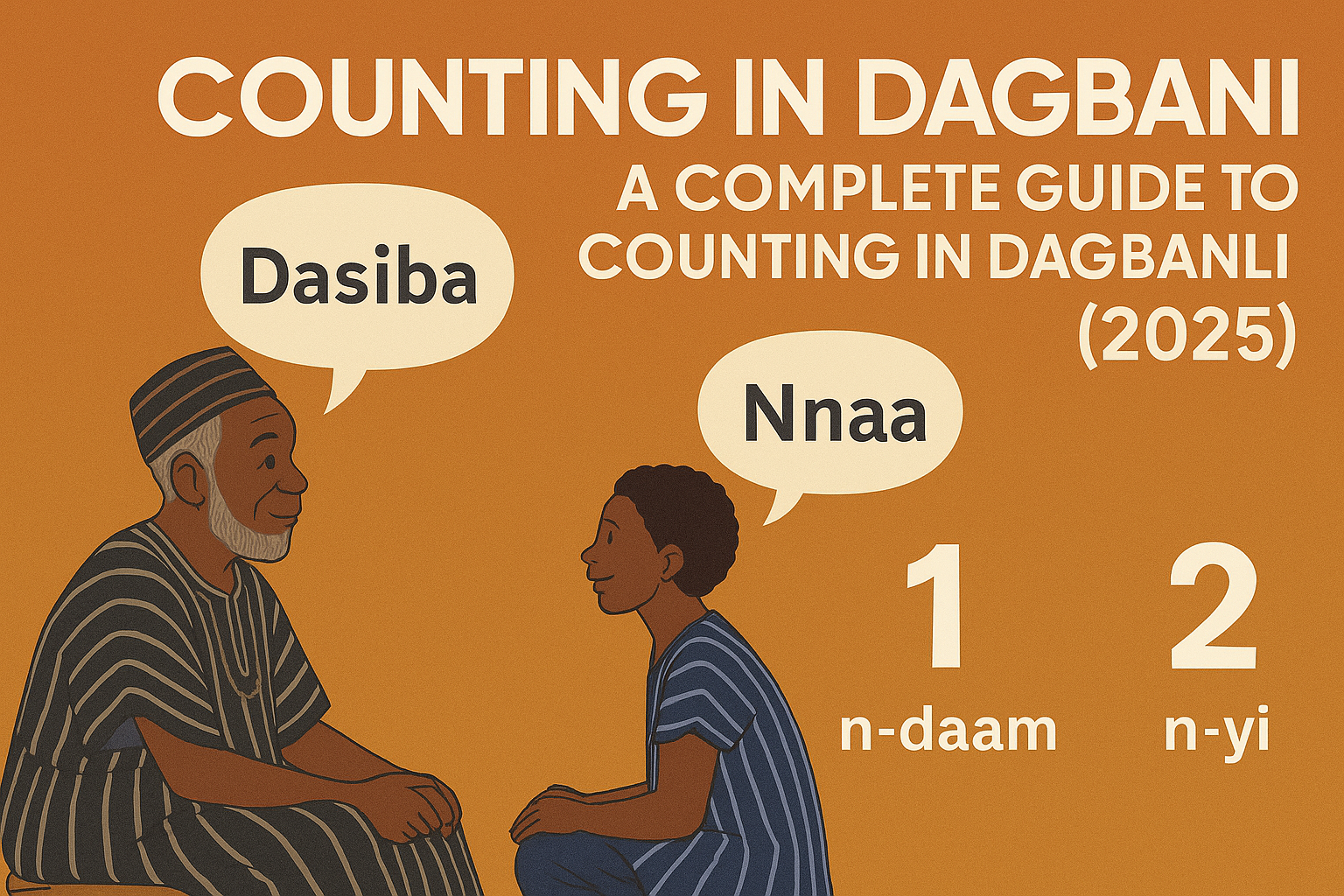
Dagbani Numbers: A Complete Guide to Counting in Dagbanli (2025)
Learning to count in Dagbani opens doors to understanding one of Ghana’s most widely spoken languages. This comprehensive guide will teach you everything about Dagbani numbers, from basic counting to everyday conversations.
What Makes Dagbani Numbers Unique?
The Dagbani number system has a fascinating feature that sets it apart from English. The language uses two distinct forms of numbers: counting numbers (for reciting sequences) and non-counting numbers (for describing quantities of objects). This distinction helps speakers communicate more precisely in daily life.
Dagbani Numbers 1-10: The Foundation
Counting Form vs Non-Counting Form
When you count “one, two, three” in sequence, you use the counting form. But when you say “give me two yams,” you use the non-counting form.
| Number | Counting Form | Non-Counting Form |
| 1 | n-daam | yini |
| 2 | n-yi | ayi |
| 3 | n-ta | ata |
| 4 | n-nahi | anahi |
| 5 | n-nu | anu |
| 6 | n-yobu | ayobu |
| 7 | m-pɔi | apɔi |
| 8 | n-nii | anii |
| 9 | n-wei | awei |
| 10 | pia | pia |
Example: “Tim’ma tomato anu” means “Give me five tomatoes.”
How to Count from 11-19 in Dagbani
Numbers 11-17 follow an additive pattern using “ni” (meaning “and”):
- 11: Pia ni yini (10 and 1)
- 12: Pia ni ayi (10 and 2)
- 13: Pia ni ata (10 and 3)
- 14: Pia ni anahi (10 and 4)
- 15: Pia ni anu (10 and 5)
- 16: Pia ni ayobu (10 and 6)
- 17: Pia ni apɔi (10 and 7)
The Subtractive Pattern for 18 and 19
Here’s where Dagbani gets interesting. Instead of saying “ten and eight,” Dagbani uses a subtractive form:
- 18: Pishi ayi ka (literally “twenty, two is not there”)
- 19: Pishi yini ka (literally “twenty, one is not there”)
Dagbani Numbers 20-100: The Tens
The decimal system in Dagbani uses specific words for each multiple of ten:
| Number | Dagbanli |
| 20 | pishi |
| 30 | pihita |
| 40 | pihinahi |
| 50 | pihinu |
| 60 | pihiyobu |
| 70 | pisopɔi |
| 80 | pihinii |
| 90 | pihiwei |
| 100 | kɔbiga |
Forming Numbers 21-97
For numbers ending in 1-7, use the additive pattern:
- 21: Pishi ni yini (20 and 1)
- 25: Pishi ni anu (20 and 5)
- 33: Pihita ni ata (30 and 3)
- 65: Pihiyobu ni anu (60 and 5)
For numbers ending in 8-9, use the subtractive pattern:
- 28: Pihita ayi ka (30 minus 2)
- 29: Pihita yini ka (30 minus 1)
- 38: Pihinahi ayi ka (40 minus 2)
- 48: Pihinu ayi ka (50 minus 2)
Large Numbers in Dagbani
- 1,000: Tuhili (plural: tusa)
- 10,000: Tusa pia
- 100,000: Kɔbiga tuhili
- 1,000,000: Miliyɔŋ (loanword)
Practical Examples: Using Dagbani Numbers in Conversation
1. Asking Someone’s Age
A: A yuma ala? (How old are you?)
B: N yun pishi ni anu. (I am 25 years old.)
2. Shopping at the Market
A: Mongu di ba ala ka a yɛn da? (How many mangoes are you buying?)
B: Di ba ata ka a yɛn da. (I am buying 3.)
3. Talking About Books
A: Buku nim a la ka mali? (How many books do you have?)
B: Buku anahi ka n mala. (I have 4 books.)
4. Family Conversations
A: Bihi a la n be a daŋ ni? (How many children are in your family?)
B: Ti yɛ la bihi apɔi. (We are 7 children.)
5. Making Travel Plans
A: Da ba ala ka yɛ n gbe Tamale? (How many days will you stay in Tamale?)
B: Biɛɣu pia ka n yɛ n gbe. (I will stay for 10 days.)
Quick Reference: Key Dagbani Number Rules
- Use counting forms when reciting numbers in sequence
- Use non-counting forms when describing quantities of objects
- Numbers 1-7: Add with “ni” (and)
- Numbers 8-9: Subtract with “ka” (minus) from the next ten
- Pattern repeats at every decade (28 = 30 minus 2, 38 = 40 minus 2)
Why Learn Dagbani Numbers?
Dagbani is spoken by over 1.5 million people in Northern Ghana, making it one of the region’s most important languages. Learning numbers helps you:
Learning Dagbani numbers connects you deeply with the Dagbon culture. It’s not just about language—it’s about identity and belonging. Knowing how to count in Dagbani helps when shopping in local markets, talking with elders, or teaching children their roots.
If you’re ready to take your learning further, explore our Learn Dagbani Online page for more lessons on grammar, greetings, and pronunciation.
- Navigate markets and shops in Dagbani-speaking areas
- Build relationships with Dagbani speakers
- Understand the cultural logic behind the language
- Communicate ages, prices, and quantities accurately
Practice Tips for Mastering Dagbani Numbers
- Start with 1-10: Master both forms before moving forward
- Practice the pattern: Notice how additive (ni) and subtractive (ka) patterns repeat
- Use real situations: Count items around you in Dagbani
- Listen to native speakers: Pay attention to pronunciation
- Practice daily: Count your routine activities in Dagbani
Conclusion
The Dagbani number system combines logical patterns with unique features like the counting/non-counting distinction and subtractive forms. Whether you’re planning to visit Northern Ghana, connect with Dagbani-speaking communities, or simply explore linguistic diversity, mastering these numbers is your first step toward fluency.
Start practicing today with the examples provided, and soon you’ll be counting confidently in Dagbanli!