Dagbani Welcome and Farewell Greetings
Dagbani welcome and farewell greetings are an important part of Dagbon culture, expressing respect, intention, and deep social meaning beyond simple “hello” or “goodbye.” Unlike many languages where a single word suffices for welcoming or bidding farewell, the Dagbani language offers nuanced greetings that communicate the nature of a visit, the relationship between people, and cultural values that have been preserved for generations. Understanding these greetings is essential for anyone seeking to connect authentically with Dagbon culture and traditions.
The Truth About “Amaraaba” – Not Indigenous Dagbani
Many people today use “Amaraaba” as the standard welcome greeting in Dagbon, but this word is not originally Dagbani. The term was borrowed from Hausa, which itself adopted it from the Arabic word “Marhaba.” While “Amaraaba” has become widely accepted and understood throughout Dagbon, it represents cultural borrowing rather than indigenous tradition.
For those committed to preserving authentic Dagbani language and culture, learning the indigenous Dagbani welcome and farewell greetings is crucial. Teaching children these traditional greetings helps maintain linguistic heritage, especially for Dagomba families living abroad who want to keep their cultural identity alive.
Indigenous Dagbani Welcome Greetings Explained
The indigenous Dagbani welcome greetings are context-specific, each designed for particular situations and carrying distinct meanings.
Naa Paabu Na – Welcome on Arrival
“Naa paabu na” is the most common indigenous welcome greeting used when someone arrives at your home or location. This phrase literally acknowledges the person’s arrival and expresses hospitality. It’s appropriate for both expected and unexpected visitors, showing respect and warmth from the moment someone steps into your compound.
Naa Sɔli – Welcome (Passing By or Approaching)
When you see someone passing by your home or approaching from a distance, “Naa sɔli” is the appropriate greeting. This Dagbani welcome greeting recognizes the person’s presence and movement, showing awareness and friendliness even before they reach your doorstep.
Naa Gɔrim – Welcome Back from a Journey
“Naa gɔrim” holds special significance among Dagbani welcome and farewell greetings because it specifically acknowledges someone’s return from a journey. Whether your father returns from a business trip, a relative comes back from traveling, or a friend returns after being away, this greeting expresses joy at their safe return and recognition of their absence.
Naa Sɔli Zuɣu Suŋ – Welcome Safely
This extended greeting, “Naa sɔli zuɣu suŋ,” emphasizes safe arrival. The phrase combines welcome with a blessing of safety, making it particularly appropriate when someone has traveled from far away or through potentially difficult conditions.
Understanding the Responses: N Gomina vs. N Kulmina
The Dagbani welcome and farewell greetings system includes two primary responses to welcome greetings, each revealing the visitor’s intentions and plans.
N Kulmina – “I Have Come Home”
When someone responds with “N kulmina” to any Dagbani welcome greeting, they are indicating their intention to stay for an extended period or that they consider this their home. The phrase literally means “I have come home.”
When to use N Kulmina:
- A family member returns home permanently or for a long stay
- Someone relocates back to their hometown
- A relative plans to stay for weeks or months
- The visitor considers this their primary residence
For example, if your father returns from a business trip and you greet him with “Naa paabu na” or “Naa gɔrim,” his appropriate response would be “N kulmina” because he is indeed coming home.
N Gomina – “I Have Come (for a Visit)”
In contrast, “N gomina” indicates a shorter visit or temporary stay. This response communicates that while the person is happy to be there, they don’t intend to stay indefinitely.
When to use N gomina:
- A friend visits for a few hours
- A relative comes for a short stay of days
- Someone stops by briefly for a specific purpose
- The visit has a defined, limited duration
Understanding this distinction in Dagbani welcome and farewell greetings prevents misunderstandings about expectations and demonstrates cultural competence. If a relative responds with “N kulmina,” you know to prepare for a longer stay and make appropriate accommodations.
Cultural Significance of Dagbani Welcome Greetings
These indigenous Dagbani welcome and farewell greetings reflect core Dagbon values of hospitality, respect, and community. Traditional Dagbani greetings serve as more than mere pleasantries—they establish social bonds, acknowledge relationships, and demonstrate cultural knowledge.
During the reigns of various Dagbon leaders, including Tolon-Na Yakubu Tali, these greeting customs have been maintained as essential elements of Dagbon identity. The precision and variety of Dagbani welcome and farewell greetings show the sophistication of Dagbon social customs.

Dagbani Farewell Greetings and Their Meanings
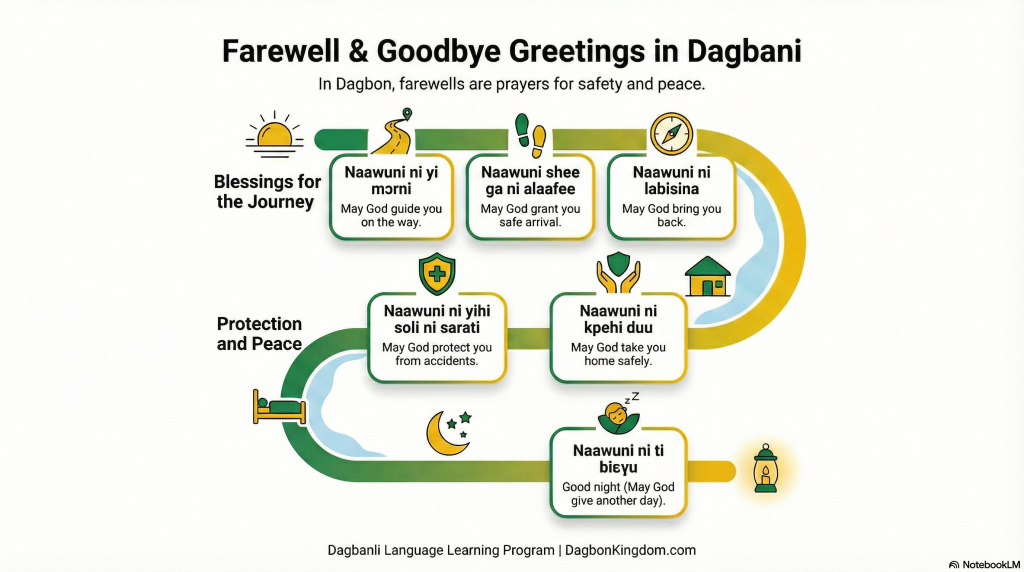
Just as welcome greetings vary by context, Dagbani farewell greetings invoke divine protection and express good wishes tailored to the departing person’s journey.
Naawuni Ni Yi Mɔrni – “May God Guide You Through the Bush”
This farewell blessing asks for divine guidance through wilderness or rural areas. Historically, when travel meant walking through bush paths, this greeting carried significant protective meaning. Today, it remains relevant for anyone traveling through rural areas or facing uncertain paths.
Naawuni Ni Kpehi Duu – “May God Take You to Your Room”
“Naawuni ni kpehi duu” expresses the wish for safe arrival at one’s destination, specifically to the intimacy and security of one’s own room. Among Dagbani welcome and farewell greetings, this one emphasizes complete safety from departure through arrival.
Naawuni Ni Labisina – “May God Bring You Back”
This farewell greeting expresses the hope for the person’s return. It acknowledges that while they must leave now, their presence is valued and their return is anticipated. “Naawuni ni labisina” strengthens community bonds by establishing expectation of future reunion.
Naawuni Shee Ga Ni Alaafee – “May God Alight You Safely”
Focusing on the journey itself, this greeting asks for divine protection during travel, that God may ensure safe passage and landing. It’s particularly appropriate for those embarking on long or potentially dangerous journeys.
Naawuni Ni Yihi Soli Ni Sarati – “May God Protect You from Accidents on the Road”
Modern travel brings modern dangers, and this farewell greeting directly addresses concerns about road safety. Among contemporary Dagbani welcome and farewell greetings, this one acknowledges the real risks of vehicle travel while invoking divine protection.
Naawuni Ni Ti Biɛɣu – “Good Night (May God Give Another Day)”
Unlike simple “good night” phrases in other languages, this Dagbani farewell greeting for nighttime carries deeper meaning. “Naawuni ni ti biɛɣu” literally asks God to grant another day, acknowledging life’s fragility and the blessing of waking to see tomorrow.
Why Dagbani Welcome and Farewell Greetings Matter Today
In an increasingly globalized world, maintaining indigenous Dagbani welcome and farewell greetings preserves cultural identity and linguistic heritage. These greetings:
- Strengthen community bonds through culturally appropriate acknowledgment
- Pass traditions to younger generations who might otherwise lose connection to their heritage
- Demonstrate cultural pride and respect for Dagbon customs
- Facilitate authentic connections between Dagomba people worldwide
- Preserve linguistic diversity in the face of dominant languages
For Dagomba families living away from traditional homelands, consciously using these greetings helps children maintain their cultural roots and understand their heritage beyond superficial symbols.
Common Mistakes with Dagbani Welcome and Farewell Greetings
Several common errors occur when people unfamiliar with the nuances of Dagbani welcome and farewell greetings try to use them:
Using only “Amaraaba”: While widely understood, relying solely on this borrowed term neglects rich indigenous alternatives that carry more precise meanings.
Mixing up responses: Saying “N kulmina” when you only intend a short visit creates confusion about your plans and can lead to awkward situations.
Using wrong context greetings: Saying “Naa gɔrim” to someone who hasn’t traveled, or “Naa paabu na” to someone just passing by, shows lack of understanding of appropriate usage.
Forgetting farewell blessings: Simply saying “goodbye” without the appropriate Dagbani farewell greeting misses an opportunity to express care and invoke divine protection.
Practical Guide to Using Dagbani Welcome and Farewell Greetings
To effectively incorporate these greetings into your interactions:
- Assess the context before choosing your greeting—is this person arriving home, passing by, or returning from travel?
- Consider the relationship and the visitor’s likely intentions when anticipating their response.
- Match your farewell to the person’s journey—are they traveling far, going home for the night, or embarking on a dangerous trip?
- Practice pronunciation to show respect and ensure clear communication.
- Teach children the meanings behind each greeting, not just the words, so they understand the cultural values embedded in Dagbani welcome and farewell greetings.
Conclusion
Dagbani welcome and farewell greetings represent far more than simple social pleasantries. They embody Dagbon values of hospitality, community, respect, and spiritual awareness. While “Amaraaba” has become common, the indigenous alternatives—Naa paabu na, Naa sɔli, Naa gɔrim, and Naa sɔli zuɣu suŋ—carry specific meanings that enrich communication and preserve cultural heritage.
Understanding the distinction between N gomina and N kulmina prevents misunderstandings and demonstrates cultural competence, while the various Dagbani farewell greetings—from Naawuni ni yi mɔrni to Naawuni ni ti biɛɣu—invoke divine protection and express genuine care for those departing.
For anyone serious about engaging with Dagbon culture, mastering these Dagbani welcome and farewell greetings is essential. They open doors to deeper connections, demonstrate respect for tradition, and help preserve a linguistic and cultural heritage that has survived for generations. Whether you’re a Dagomba person reconnecting with your roots or someone learning about this rich culture, these greetings offer a meaningful way to honor Dagbon’s past while building its future.