When we speak of Africa’s great kingdoms, we often focus on the monarch—the visible embodiment of power and tradition. Yet the true genius of these states lies not in individual rulers, but in the sophisticated institutions that sustain them across centuries. The Kingdom of Dagbon, one of West Africa’s oldest and most meticulously organized traditional states, offers a masterclass in distributed authority through its dual council system: the Yani Kpamba and the Yɔɣu Kpamba.
Understanding these two bodies is essential to grasping the Dagbon governance structure—a political framework that has endured for over five centuries by balancing executive power, judicial integrity, and democratic representation long before colonial intervention introduced Western models of statecraft.
The Foundation: Understanding the Yaa-Naa’s Authority
At the apex of Dagbon sits the Yaa-Naa, whose title translates to “King of Strength” or “King of Absolute Power.” From his seat in the traditional capital of Yendi, he serves as supreme overlord, commander-in-chief, chief justice, and head of the legislative body. Yet despite this formidable array of titles, the Overlord does not rule alone. Traditional wisdom describes him as being “like an egg”—powerful yet fragile, requiring the protection and guidance of his elders to function effectively.
This metaphor reveals the essence of traditional leadership in Dagbon: power is not concentrated in a single office but distributed across councils, guilds, and territorial chiefs to maintain social and spiritual equilibrium.
Yani Kpamba: The Inner Cabinet of Yendi
Who Are the Yani Kpamba?
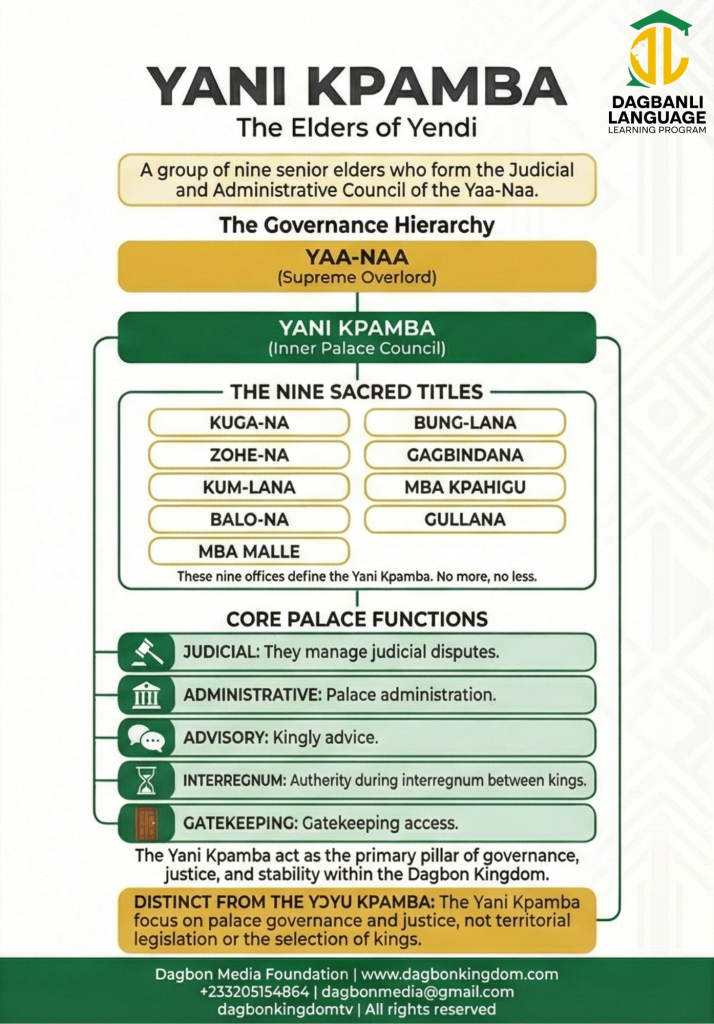
The term Yani Kpamba literally translates to “Elders of Yendi” or “Elders of the Yaa-Naa.” These nine senior officials form the immediate inner circle and cabinet to the Overlord, serving as the administrative and judicial backbone of the capital.
Historically, members of the Yani Kpamba were recruited from non-princely circles—often as eunuchs—to ensure their absolute loyalty to the monarch remained uncompromised by dynastic ambitions. This deliberate separation from royal bloodlines prevented conflicts of interest and guaranteed that their counsel served the state rather than personal advancement.
The Nine Members of the Judicial Council
The composition of the Yani Kpamba is fixed and strictly defined:
- Kuga-Na: The senior-most advisor who administers the state during an interregnum
- Zohe-Na: Regarded as the “elder brother” of the Yaa-Naa and principal counsellor
- Kum-lana: The “owner of death,” responsible for royal funeral arrangements
- Balo-Na: Senior counsellor managing the Balogo quarter of Yendi
- Mba Malle: Attendant handling royal household matters and Muslim relations
- Bung-Lana: Head of Bunga suburb who officiates at royal ceremonies
- Gagbindana: Counsellor participating in sacred selection rituals
- Mba Kpahigu: Counsellor with significant judicial responsibilities
- Gullana: Personal attendant hosting royal candidates during enskinment
Core Functions: More Than Advisors
The Yani Kpamba perform three essential roles within the Dagbon chieftaincy system:
Judicial Authority: They constitute the highest traditional court under the Yaa-Naa, adjudicating land disputes, criminal cases, and disagreements between chiefdoms. The Overlord acts as judge while the Yani Kpamba serve as assessors, with smaller tribunals handling minor cases.
Palace Administration: Beyond judicial duties, these elders manage daily palace operations, oversee the royal treasury, formulate state legislation, and even supervise the upbringing of royal children. They effectively run the government from the royal court.
Gatekeepers of Access: Every divisional chief, regardless of rank, must approach the Yaa-Naa through a designated patron among the Yani Kpamba, whom they address as “ba” (father). This gatekeeping mechanism prevents any single chief from gaining undue influence while keeping the elders informed of territorial developments.
During an interregnum—the period between a king’s death and his successor’s enskinment—the Kuga-Na assumes temporary control of the state while the Kum-lana remains with the deceased king’s body until the funeral is formally announced.
Yɔɣu Kpamba: The State Elders and Electoral College
Who Are the Yɔɣu Kpamba?
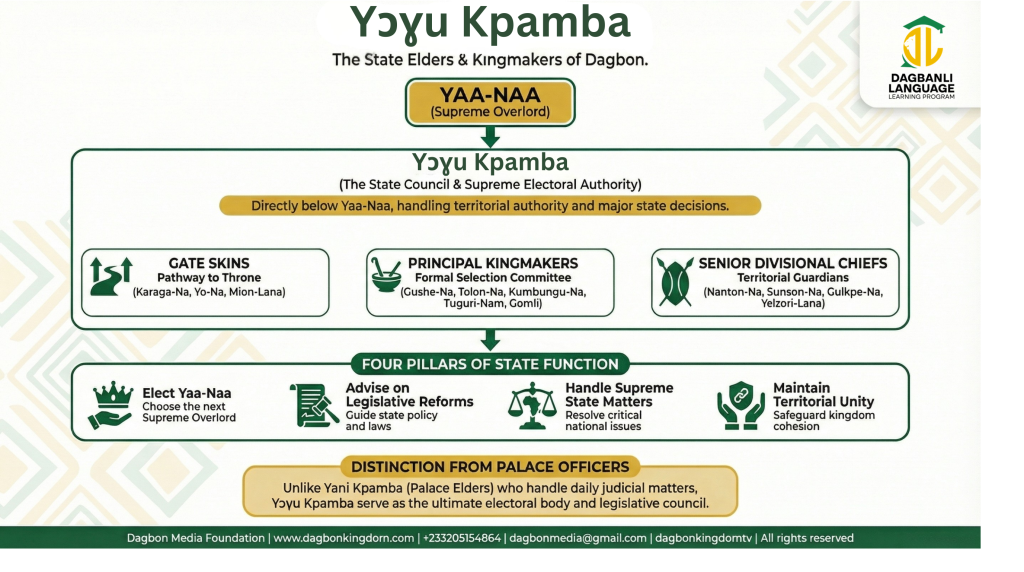
While the Yani Kpamba manage the capital, the Yɔɣu Kpamba (State Elders or Chiefs of the Domain) represent the broader territorial interests of the entire kingdom. Unlike the nine elders permanently based in Yendi, this body comprises powerful divisional chiefs who rule vast provinces throughout Dagbon.
The Yɔɣu Kpamba form the Dagbon State Council—a legislative assembly summoned only for matters of “supremo importance” such as declaring war, selecting a new Yaa-Naa, or fundamentally changing ancient customs.
Key Members and Their Roles
The membership includes the most prestigious territorial rulers:
Principal Kingmakers:
- Gushie-Na: Customary leader of the selection body, holding the ritual power to formally declare the end of a reign and identify the new king
- Tolon-Na: First Minister and supreme commander of the state cavalry
- Kumbungu-Na: Commander of state archers and senior military elder
- Tuguri-Nam: Senior ritual elder permitted to touch the sacred Bolon during investiture
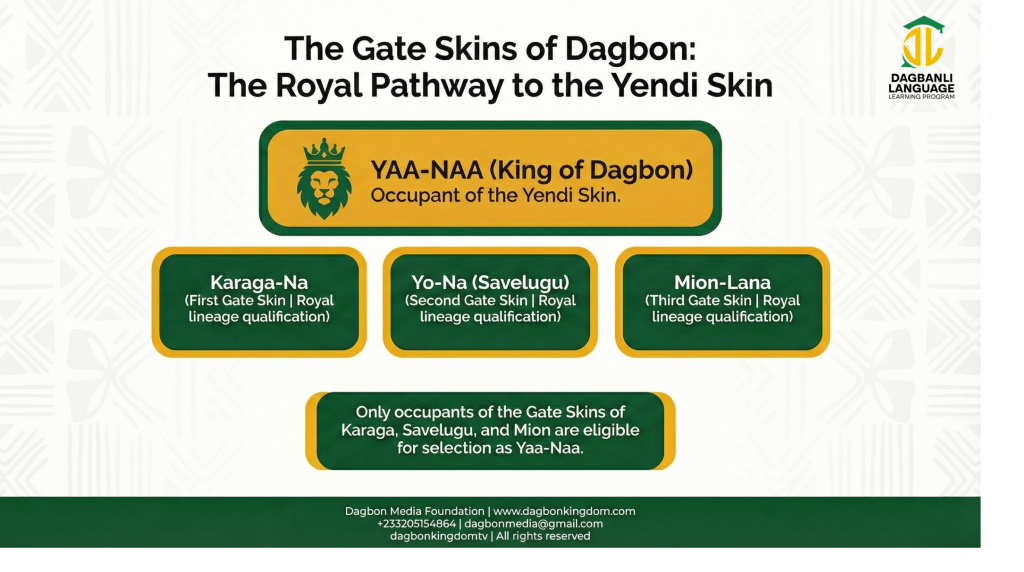
Gate Skin Chiefs (candidates for the paramountcy):
- Karaga-Na: Occupant of the first gate to Yendi
- Yo-Na (Savelugu): Chief of the largest and wealthiest province
- Mion-Lana: Third duke responsible for performing final funeral rites of deceased kings
Senior Divisional Chiefs:
- Nanton-Na: Addressed by the Yaa-Naa as “Ba-kpema” (my father’s elder brother)
- Sunson-Na: Vital member providing critical dynastic advice
- Gulkpe-Na: Divisional chief responsible for the royal ancestor cult
- Yɛlzori-Lana: Senior chief and traditional elector for the Yendi skin
Why They’re Called the “Dagbon Kingmakers”
The Yɔɣu Kpamba earn the title Dagbon kingmakers through their unique mandate to select, invest, and ensure the legitimacy of each new Yaa-Naa. This process combines spiritual divination with political deliberation:
- Divination: A selection committee led by the Kuga-Na, Tuguri-Nam, and Gomli consults ancestral spirits to identify a candidate with a “good head”
- Ritual Identification: The Gushie-Na rides ceremonially around the royal burial chamber and seizes straw from the palace roof, handing it to the successful candidate
- The Arrest (Ngbai): The king-elect is “arrested” by kingmakers and led to the royal mausoleum
- The Bolon Ceremony: Inside the sacred Katini Duu, the candidate sits three times on the Bolon—a sacred stool imbued with ancestral souls—transforming him into a Bumbiogo, a fearful object of spiritual power
Only candidates from the three “Gate Skins” (Karaga, Mion, and Savelugu) may contest for Yendi, following the constitutional rule that “a son may never rise higher than his father.”
How Yani Kpamba and Yɔɣu Kpamba Work Together
The brilliance of the Dagbon governance structure lies in how these two councils complement each other, creating a sophisticated system of checks and balances.
Complementary Jurisdiction
| Feature | Yani Kpamba | Yɔɣu Kpamba |
|---|---|---|
| Location | Permanently in Yendi | Distributed across kingdom |
| Size | Nine senior officials | Broader body of territorial chiefs |
| Authority | Executive and Judicial | Legislative and Electoral |
| Scope | Daily palace administration | Matters of supreme importance |
| Role | Judicial Council | State Council |
Shared Responsibility in Succession
During an interregnum, the two councils demonstrate their interconnected authority:
- The Yani Kpamba provide executive stability—the Kuga-Na administers the state while the Kum-lana oversees burial rites
- The Yɔɣu Kpamba arrive from across the kingdom as an electoral college to finalize succession
- Ritual kingmakers from both bodies collaborate—Yendi elders conduct spiritual divination while the Gushie-Na provides political validation
This shared responsibility ensures that successors are both spiritually validated by the inner council and politically accepted by territorial chiefs who command military and economic resources.
The 1948 Constitutional Reform
A pivotal moment in this relationship occurred in 1948 when the selection committee expanded from a small group of ritual specialists to include eleven members, incorporating powerful divisional chiefs like the Tolon-Na and Kumbungu-Na. This reform was intended to “democratize” the process, though it later created tensions when ritual elders and the formal committee nominated different candidates in 1968—highlighting the ongoing balance between traditional spiritual authority and modern political legitimacy.
Why This System Represents Advanced Statecraft
The dual council structure of the Yaa-Naa council demonstrates principles of governance that were remarkably sophisticated for pre-colonial Africa:
Separation of Powers: The system distinguishes between ritual authority (earth priests and kingmakers), judicial authority (Yani Kpamba), and territorial authority (Yɔɣu Kpamba), preventing over-centralization.
Distributed Authority: By replicating the court structure at divisional and village levels, Dagbon operates as a “segmentary state”—allowing local autonomy while maintaining national unity.
Checks and Balances: The Gundo-Naa (senior female chief) possesses unique power to veto the king’s word, while divisional chiefs can refuse to follow a paramount into war if consensus wasn’t reached.
Institutional Continuity: The promotional “gate system” ensures potential successors are groomed through lower chieftaincies, creating a pool of experienced leaders.
The Enduring Legacy
Despite colonial partition in 1899 and subsequent reunification in 1920, the Dagbon chieftaincy system survived because its structured authority remained “locked in the minds” of the people. The interplay between Yani Kpamba and Yɔɣu Kpamba has allowed the kingdom to absorb external shocks and manage intense internal dynastic competition.
This is the essence of traditional leadership in Dagbon: while kings may pass, the “Nam” (chieftaincy) never dies. The Yani Kpamba protect the person of the king and the integrity of the capital, while the Yɔɣu Kpamba protect the territory and ensure representation of the various gates. Together, they form a resilient institution—a testament to the sophistication of African political heritage.
Understanding the Yani Kpamba and Yɔɣu Kpamba is not merely an academic exercise. It reveals how traditional African states developed complex constitutional frameworks that balanced monarchical authority with democratic representation, judicial independence, and territorial integrity—principles that remain relevant to governance debates across the continent today.
Read More: who was naa gbewaa