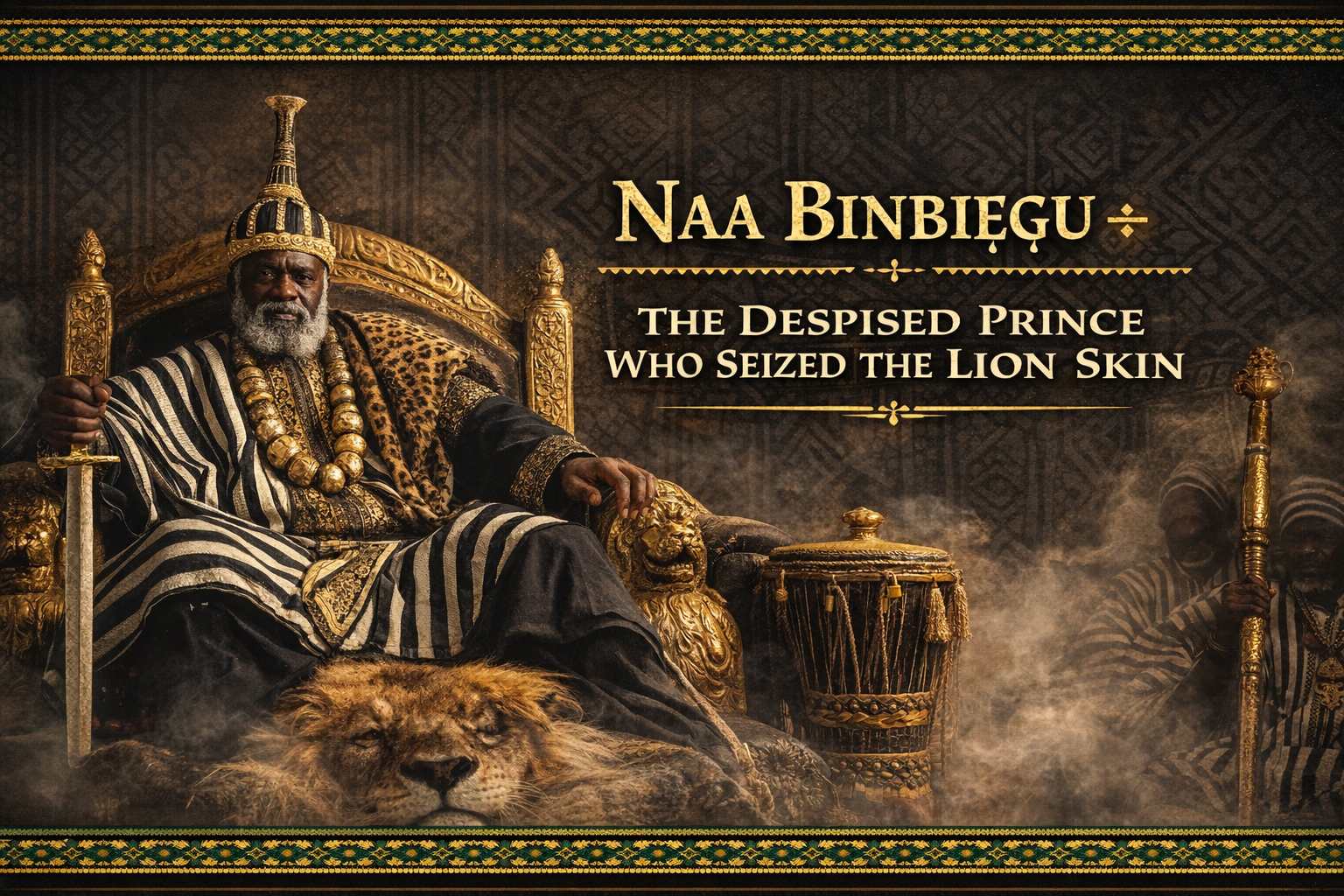
In the long roll of Dagbon kings, few stories grip the imagination quite like that of Naa Binbiɛɣu. Born into the most prestigious bloodline of the kingdom, he spent his formative years as a starving, disease-ridden laughingstock — mocked by the very court that would one day bow before him. His journey from the wilderness to the palace is not merely history; it is a testament to the belief, still alive in Dagbon today, that the magic of the regalia and the will of the ancestors can transform even the most unlikely soul into a great chief.
Royal Blood, Humble Beginnings: The Lineage of Naa Binbiɛɣu
Naa Binbiɛɣu — whose royal name was Zuu Jiŋli — was no stranger to greatness by birth. He was the eldest son (Zuu) of Naa Zangina, the 16th King of Dagbon, who reigned from 1648 to 1677 and holds the historic distinction of being the first Dagbon king to formally embrace Islam. Through his grandmother, Napaɣ’Nanga — a woman of commanding character and the mother of Naa Zangina — Binbiɛɣu was said to have inherited a fierce inner strength that his outward appearance would long conceal.
He succeeded Naa Andani Siɣili (r. 1677–1687), the warrior-king who had led Dagbon’s forces against the Gonja invasion. But before that succession could happen, Binbiɛɣu would endure years that would have broken a lesser man.
Quick Facts
Full Royal Name: Zuu Jiŋli | Known As: Naa Binbiɛɣu | Reign: 1687–1700 | Father: Naa Zangina (16th King) | Position in succession: 18th Yaa Naa of Dagbon
The Years of Ridicule: A Prince Cast Into the Wild
Dagbon custom dictates that “no little lion is raised in his father’s hut.” True to this tradition, the young prince was sent away from his father’s palace to be nurtured under the authority of the Zohe-Naa. It was there that his suffering began.
His daily duty was to feed and tend the horses, a task that sent him trudging through the wilderness until he returned half-dead from exhaustion. Hunger was a constant companion. On the rare occasions food was given to him, he was forced to eat hot T.Z. (tuo zaafi, the local staple) directly from his bare palms — a deliberate humiliation designed to remind him of his lowly status in that compound.
“From the crumbs he ate off his burning palms, he saved morsels — tanning them into a leather amulet that he wore for the rest of his life.”
Far worse than hunger was what came next. Denied adequate water for bathing and living in conditions of extreme neglect, the prince developed a severe skin disease known in Dagbanli as Gbani — an affliction that covered his face and body in unsightly rashes and spots. To the court of Yendi, already inclined to overlook him, this was confirmation of his worthlessness. He became a laughingstock among his peers. The cruel nickname Binbiɛɣu — meaning “the ugly one” or “unsightly creature” — was pinned to him, and it stuck.
It is one of history’s great ironies that the name meant to shame him would eventually be spoken with reverence across Dagbon for generations.
The Wandering Prince Finds His Healer: Afa Abdulai of Kpatinŋa
Driven beyond endurance by the contempt of Yendi’s elders — including the Balo Naa and the Kum-Lana — the young prince fled. He made his way to Kpatinŋa, wandering the roads in search of anyone who might offer a cure for his wretched condition.
It was there, in front of a modest house, that he encountered a Muslim cleric seated quietly in the open air, reciting the Quran. The man’s name was Afa Abdulai. Unlike the nobles of Yendi who saw only disease and disgrace, Afa Abdulai looked at the suffering young man and recognised his royal status. He took the prince in without hesitation.
The treatment that followed was a combination of the spiritual and the practical: hot water baths and Quranic potions, administered with care and faith. Slowly but surely, the prince’s skin cleared. The disease that had defined his identity — the very affliction that earned him his mocking name — vanished. His health, his dignity, and his sense of self were restored.
This encounter with Afa Abdulai also deepened the prince’s connection to Islam — a faith his own father, Naa Zangina, had been the first Dagbon king to formally adopt. The thread of Islamic influence running through the royal family had found a powerful new expression in the prince’s miraculous healing.
Passed Over: The Regent Who Was Not Yet King
When his father Naa Zangina died, Binbiɛɣu returned to Yendi. As the eldest son, he served as the Regent of Dagbon — a position of responsibility but not of supreme power. The kingmakers, however, chose to install Naa Andani Siɣili as the substantive king, a decision that saw Binbiɛɣu step aside. For ten years, he waited.
Naa Andani Siɣili proved himself a capable ruler and military leader, most notably commanding Dagbon’s resistance during the Gonja invasion. But when Siɣili died in 1687, Binbiɛɣu returned to Yendi once more to press his claim — and this time, destiny would intervene in the most dramatic fashion imaginable.
The Moment That Changed Everything: The Seizure of the Sacred Regalia
During the funeral rites of Naa Andani Siɣili, the royal court of Yendi gathered in the customary manner. Also present were the royal princesses, among them the Gundo Naa and the Kum-Lana. To them, Binbiɛɣu was still the same figure they had always known — the ugly, impoverished outcast with the embarrassing past. They had not updated their picture of him.
In the loose, playful atmosphere of the funeral gathering, the women began to tease him. As a joke, they draped the Yaa Naa’s sacred regalia over his shoulders — the robes, the symbols, the very items that constituted the authority of the king of Dagbon. They wanted to see how the ridiculous man would look dressed as a king.
“Once the regalia touched his shoulders, Binbiɛɣu did not laugh. He did not play along. He ran.”
Breaking free from the startled women, he dashed into the palace hall — at precisely the moment the royal drummers sounded the Gingaani, the sacred rhythm played to announce a new king. The court froze. The elders and kingmakers looked at a man adorned in the full regalia of the Yaa Naa, standing inside the palace, as the drums of installation rang out around him.
Their verdict was swift and unambiguous: to remove the regalia now, in public, after the Gingaani had sounded, would bring irreversible shame upon the kingdom. The ancestors had spoken through circumstance. The elders declared that the sacred items had already bestowed their authority. Binbiɛɣu was installed as Yaa Naa — the King of Dagbon.
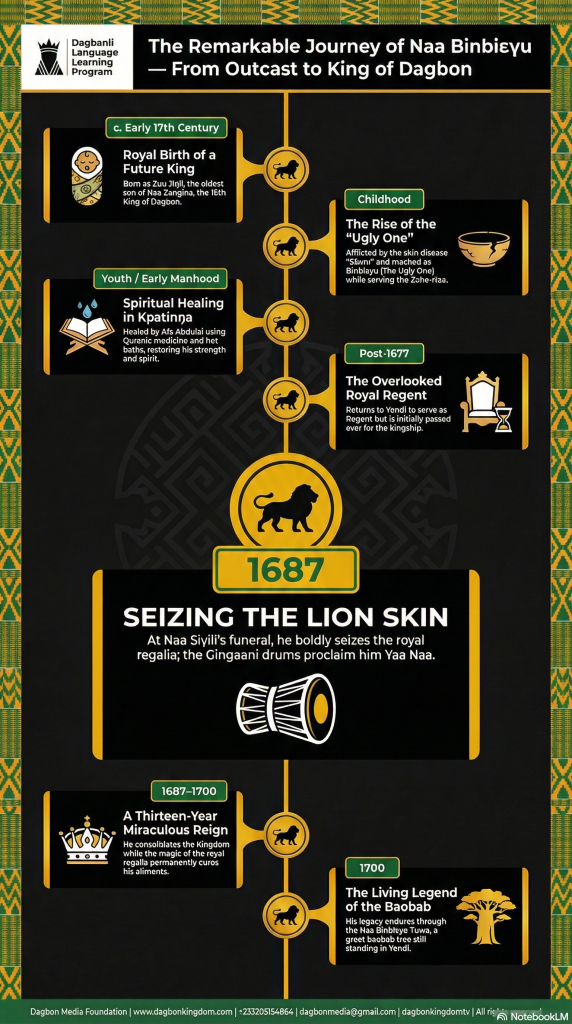
The Arc of a King: A Life in Milestones
c. Early 17th Century
Born as Zuu Jiŋli, eldest son of Naa Zangina, 16th King of Dagbon.
Childhood
Sent to the Zohe-Naa compound per custom. Years of hunger, servitude, and neglect follow. Develops the skin disease Gbani; earns the cruel nickname Binbiɛɣu.
Youth / Early Manhood
Flees to Kpatinŋa. Encounters Afa Abdulai, who heals him with hot baths and Quranic medicine. His skin clears and his strength returns.
Post-1677
Returns to Yendi after Naa Zangina’s death. Serves as Regent of Dagbon but is passed over for the kingship in favour of Naa Andani Siɣili.
1687
At Naa Andani Siɣili’s funeral, seizes the royal regalia in the most dramatic installation in Dagbon history. Proclaimed Yaa Naa — King of Dagbon.
1687–1700
Reigns for 13 years. Consolidates the state, raises a dynasty, and earns lasting respect. Oral tradition says the “magic of the regalia” permanently cured his remaining ailments upon installation.
1700
Naa Binbiɛɣu passes. His legacy lives on in his progeny, in oral tradition, and in the great baobab tree — Naa Binbiɛɣu Tuwa — that still stands in the Baloɣu-Fonŋ suburb of Yendi.
Reign and Legacy: The Unlikely King Who Delivered
One might expect a king installed under such chaotic circumstances to face a fragile, contested reign. Instead, Naa Binbiɛɣu proved himself a capable, consolidating leader. The man the court had dismissed governed with authority and purpose for 13 years.
Dagbon oral tradition holds that the very act of wearing the sacred regalia completed his healing. The final vestiges of his yaws and skin ailments disappeared after his installation — a miracle attributed to the magic of the regalia and the blessing of his ancestors. It was as though the kingdom itself was acknowledging the rightness of his reign.
He fathered several children who would go on to occupy significant positions in Dagbon governance. His eldest prince was Piɛnŋ-Lana Mahami, followed by Piɛnŋ-Lana Abudu. His other children included Nasa Lana Amuɣutaani, Nabiri Naa Mbariba, and Nabia Yɔnŋ Tukasa. His regentess was Paɣabi Lana Ataya.
Naa Binbiɛɣu Tuwa — The Baobab of a King
Perhaps no memorial is more fitting for a man of his character than the one nature itself provides. In the Baloɣu-Fonŋ suburb of Yendi stands a massive, ancient baobab tree known as Naa Binbiɛɣu Tuwa — “the strange baobab of Naa Binbiɛɣu.” This tree marks the site where the king once maintained his protective shrines and the amulets that had accompanied him through his darkest years. Like the man himself, it endures — extraordinary, unmistakable, rooted in the soil of Dagbon.
What Naa Binbiɛɣu Teaches Us
The story of Naa Binbiɛɣu is not simply a tale of a man who got lucky. It is the story of a prince who survived humiliation, healed in faith, waited with patience, and — when the moment came — was bold enough to claim what was always his. Dagbon history is full of warriors and scholars, but it is this moment — a mocked outcast sprinting through a palace hall in sacred robes, the Gingaani drums sounding — that reminds us why oral tradition is irreplaceable. It carries truths that written records alone cannot hold.
Continue Exploring Dagbon History
Yani Kpamba and Yogu Kpamba: Understanding Dagbon Governance